
Board and setup
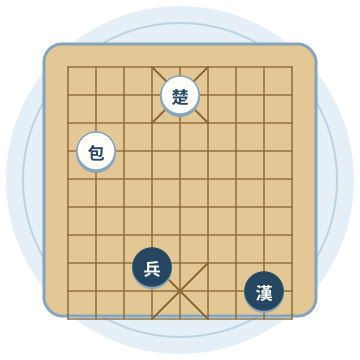
A 9×10 point board with a 3×3 palace (with diagonals) on each side. Cho, the first player, sits at the bottom; Han sits at the top.
Traditional / JANGGI
Diagonal palace lines turn chariots and cannons loose.
Also known as: Korean Chess
Janggi shares its roots with xiangqi, but allows diagonal moves inside the palace, giving its chariot and cannon their own distinct character.
—online now · 0 matching
Supports ranked matches, friend invites, AI opponents, spectating.
Play instantly in your browser · guests welcome
 JANGGI
ABOUT THE GAME
Janggi (장기) is a traditional game of the Korean peninsula. It belongs to the same family of general-versus-general games as xiangqi, and scholars generally agree the two share historical roots, though the exact path and timing of that connection are still debated.
It keeps the basic palace-and-general layout, while developing its own character in the proportion of elephant and horse moves and the cannon’s screening rule — and it allows moving straight along the palace diagonals as well.
Reference:www.britishmuseum.org ↗
Rules
Youzai Board Game Club — The server implementation governs play here; tournament and other site rules may differ.
A 9×10 point board with a 3×3 palace (with diagonals) on each side. Cho, the first player, sits at the bottom; Han sits at the top.
The general and guards move only within the palace, orthogonally or along its diagonals. The elephant moves one straight step then two diagonal steps, and every point on that path must be empty. The knight is blocked the same way as in xiangqi. The chariot and cannon may also cross the palace diagonally through its centre. A cannon must jump exactly one non-cannon piece to capture, and cannot itself be captured that way. Soldiers move forward or sideways only, never backward.
A checkmated side loses. Either side may pass whenever it is not in check, so there is no draw for "no legal move but not in check."
This site uses a fixed standard setup and gives soldiers no palace-diagonal bonus. Two hundred half-moves without a capture draw. Unlike xiangqi, the two generals may face each other directly on an open file here.
Complete beginner guide
Read these steps in order to complete your first game. This guide combines public rules with this site’s server implementation; where versions differ, this site’s ruling applies.
Cho (초, blue-green) starts at the bottom and moves first; Han (한, red) is at the top. The 9×10 board has no river; each end has a 3×3 palace marked with diagonal lines. Checkmating the enemy general wins the game.
The general and guards only move inside the palace: one point orthogonally, or one point along the palace diagonals connecting the corners through the centre. The elephant moves one point straight, then two points diagonally, and both intersections along that path must be empty of any piece. The knight makes an L-shaped move with the same blocking rule as in xiangqi.
The chariot slides orthogonally, stopping at or capturing the first piece it meets. Inside the palace it can also move along the diagonals, from a corner to the centre or straight across to the opposite corner. The cannon moves like the chariot when not capturing; to capture, exactly one piece — the screen — must stand between it and the target. That screen cannot be another cannon, and a cannon can never be captured that way either; the same restriction applies on the palace diagonals.
Soldiers move one point forward or sideways only, never backward. Either side may choose to pass — ending the turn without moving — whenever it is not in check, so this site never produces a position with no legal move but also no check. This site uses a fixed standard starting setup, and 200 half-moves without a capture is a draw.
General rules reference:www.britishmuseum.org ↗