
Board and setup
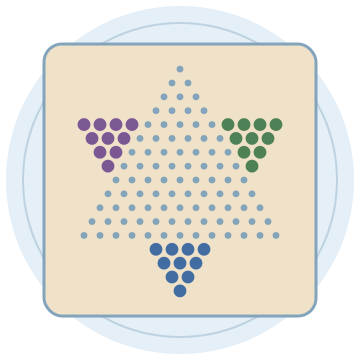
A six-pointed star with 121 holes; each player has ten marbles in one point. Two players use opposite points, three use alternate points, four use two opposite pairs, and six fill every point.
Other games / CHINESECHECKERS
Two to six players race their marbles across the star by chaining hops.
Also known as: Sternhalma
Two to six players race from the points of a star to the opposite corner, chaining hops as they go.
—online now · 0 matching
Supports friend invites, AI opponents, spectating.
Play instantly in your browser · guests welcome
 CHINESECHECKERS
ABOUT THE GAME
Despite its name, Chinese checkers did not come from China. It was invented in Germany in 1892 as “Stern-Halma”, a variation of the older American game Halma; the name “Chinese checkers” was a marketing idea of Bill and Jack Pressman in the United States in 1928.
It is one of the few board games for two to six players: each player starts in a point of the star and races to the opposite point. There is no capturing, only hops over other marbles, and after the winner finishes the others play on for second, third and later places.
Reference:en.wikipedia.org ↗
Rules
Youzai Board Game Club — The server implementation governs play here; tournament and other site rules may differ.
A six-pointed star with 121 holes; each player has ten marbles in one point. Two players use opposite points, three use alternate points, four use two opposite pairs, and six fill every point.
Turns go clockwise. Move one marble either one step to an adjacent empty hole, or hop over an adjacent marble of any colour to the empty hole directly beyond, and keep hopping if you can. A move is either a step or hops, never both. There is no capturing.
The first player to bring all ten marbles into the opposite point wins; the others play on to decide every place.
Site rules: if the opposite point is full and at least one marble there is yours, you have finished (so nobody can block your home); a player with no move passes; each player makes at most 200 moves; a player who leaves, times out or resigns is taken over by the AI and placed last.
Complete beginner guide
Read these steps in order to complete your first game. This guide combines public rules with this site’s server implementation; where versions differ, this site’s ruling applies.
Each player has ten marbles in one point of the star: two players use opposite points, three use alternate points, four use two opposite pairs and six fill every point. Bring all ten marbles into the opposite point.
Move one marble per turn. It may step into any adjacent empty hole in the six directions.
If an adjacent hole holds a marble and the hole directly beyond it is empty, you may hop over it, and keep hopping from where you land. Hopped marbles are not captured, and any colour can be a stepping stone. A single move is either a step or hops, never both.
Play goes clockwise around the board. A player with no legal move passes automatically.
The first player with every marble home wins, and the rest play on to decide every place. Site rules: a full opposite point that contains at least one of your marbles counts as finished; each player makes at most 200 moves; a player who leaves, times out or resigns is taken over by the AI and placed last.
Lay out a ladder of marbles one hole apart so the rest can hop along it, keep stragglers moving, and borrow other players' marbles as stepping stones.
General rules reference:en.wikipedia.org ↗