
Board and setup
This site uses an 11×11 hexagonal grid; Black plays first.
Abstract strategy / HEX
Connect your two opposite edges.
Hex is an abstract connection game where every move contests a key point on the board.
—online now · 0 matching
Supports ranked matches, friend invites, AI opponents, spectating.
Play instantly in your browser · guests welcome
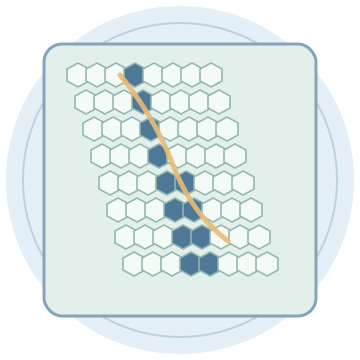 HEX
HEXABOUT THE GAME
Hex is a connection game that emerged in the twentieth century. Danish mathematician Piet Hein and American mathematician John Nash each independently proposed the game.
Each player tries to connect their own pair of opposite edges of the board; what looks like a quiet, capture-free position is in fact a constant contest over routes, blocking, and the advantage of moving first.
Reference:library.ethz.ch ↗
Rules
Youzai Board Game Club — The server implementation governs play here; tournament and other site rules may differ.
This site uses an 11×11 hexagonal grid; Black plays first.
Place a stone on any empty cell. Same-colour stones connect through six neighbours; stones neither move nor capture.
Black connects top to bottom; White connects left to right.
This site has no swap opening rule and no draw settlement.
Complete beginner guide
Read these steps in order to complete your first game. This guide combines public rules with this site’s server implementation; where versions differ, this site’s ruling applies.
This site uses an 11×11 hexagonal board. Black’s goal is to connect the top and bottom edges; White’s goal is to connect the left and right edges.
Each turn, place one stone on any empty cell. Every cell has six neighbours, and same-coloured stones touching each other extend a connected path — the path can bend freely and does not need to run in a straight line.
If two chains of your colour are separated by a single empty cell, claiming that cell joins them into one chain. The opponent may claim it first, forcing you to find another route. Stones never move and are never captured.
A player wins by connecting their own two target edges. This site has no swap-sides opening rule and no draw resolution branch.
General rules reference:library.ethz.ch ↗