
Board and setup
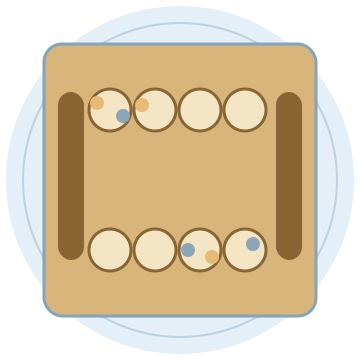
A ring of 14 pits: six houses and one store per side, four seeds in every house at the start.
Other games / MANCALA
Sow seeds, time your captures.
Also known as: Kalah, Kalaha
Mancala is a family of ancient counting games built around sowing seeds, capturing, and earning extra turns through pure calculation and planning.
—online now · 0 matching
Supports ranked matches, friend invites, AI opponents, spectating.
Play instantly in your browser · guests welcome
 MANCALA
ABOUT THE GAME
Mancala broadly refers to a large family of traditional sowing games, widely played across Africa, the Middle East and parts of Asia, with rules and board sizes varying by region. This site uses the most widely played ruleset, Kalah, which was formalised and popularised in the mid-twentieth century by William Julius Champion Jr.
These games have no notion of attack and defence between pieces; instead, players win through precisely calculating sowing paths and capture timing — a strategy game built purely on counting and planning.
Reference:www.britishmuseum.org ↗
Rules
Youzai Board Game Club — The server implementation governs play here; tournament and other site rules may differ.
A ring of 14 pits: six houses and one store per side, four seeds in every house at the start.
Pick a non-empty house on your side and sow its seeds one by one into each following pit, skipping your opponent's store.
Landing your last seed in your own store earns another turn. Landing it in an empty house of yours whose opposite house has seeds captures both into your store. The game ends once either side's six houses are empty; the other side sweeps their remaining seeds into their store, and whoever has more wins.
Seeds have no owner — only houses and stores do. If the opposite house is also empty, the seed just stays where it landed.
Complete beginner guide
Read these steps in order to complete your first game. This guide combines public rules with this site’s server implementation; where versions differ, this site’s ruling applies.
The board is a ring of 14 pits: you have six houses and one store on your side, and your opponent has the same on theirs. Each house starts with four seeds, and both stores start empty. On your turn, choose one non-empty house on your side and sow all of its seeds one by one into the pits that follow.
Sowing moves in a fixed direction around the ring: through the rest of your own houses, into your own store, then through your opponent’s houses — but your opponent’s store is always skipped, so a seed can never land there. With enough seeds in a house, sowing can go around the board more than once, and the same house may be passed through twice in a single turn.
If your last seed lands exactly in your own store, you immediately get another turn. If your last seed lands in a house on your side that was empty, and the opposite house has seeds in it, you capture both — the seed you just placed and everything in the opposite house — into your store. If the opposite house is also empty, that last seed simply stays where it landed.
The game ends the moment a player finds all six of their houses empty on their turn; the other player then sweeps every remaining seed on their own side into their own store. Whoever has more seeds in their store wins, and equal totals are a draw. Seeds themselves belong to no one — only houses and stores have an owner.
General rules reference:www.britishmuseum.org ↗