
Board and setup
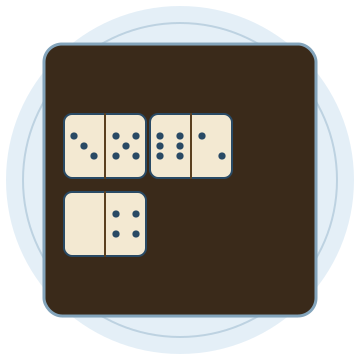
28 tiles; each player is dealt 7, and the remaining 14 sit unused in the boneyard for the whole game.
Other games / DOMINOES
Match the ends, shed your doubles first.
Dominoes has simple rules but rewards a sense of rhythm — shedding your hard-to-match doubles in time and reading when to pass is the key to winning.
—online now · 0 matching
Supports ranked matches, friend invites, AI opponents, spectating.
Play instantly in your browser · guests welcome
 DOMINOES
ABOUT THE GAME
The exact origin of dominoes remains undetermined; scholars generally link it historically to earlier dice games. It spread widely across Europe from the eighteenth century onward, and later around the world, evolving into many regional variants and rule families.
The Western double-six Block rules used on this site are the most widely played starter version: there’s no need to track probabilities or keep a complex score sheet — winning comes from matching tiles precisely and shedding hard-to-play doubles at the right moment, a simple game that still rewards planning.
Reference:www.britishmuseum.org ↗
Rules
Youzai Board Game Club — The server implementation governs play here; tournament and other site rules may differ.
28 tiles; each player is dealt 7, and the remaining 14 sit unused in the boneyard for the whole game.
Whoever holds the highest double leads and plays it automatically. After that, play a tile matching either open end of the chain if you can; otherwise you must pass.
Playing your last tile wins immediately. If both players pass in a row, the game is blocked: whoever holds fewer total pips wins, and equal totals draw.
Doubles can only be matched when their value comes up again on the chain, so they tend to get stuck in your hand — this site's AI sheds them early.
Complete beginner guide
Read these steps in order to complete your first game. This guide combines public rules with this site’s server implementation; where versions differ, this site’s ruling applies.
Western double-six dominoes uses 28 tiles; each player is dealt 7, and the remaining 14 sit in the boneyard — this site uses the Block rules, so the boneyard is never drawn from during the whole game. Whoever holds the highest double (for example, 6-6 beats 5-5) plays first and must open with that double; the site plays this opening tile for you automatically.
The public chain of tiles always has exactly two open ends — the leftmost and rightmost tile. On your turn, if any tile in your hand shares a number with either open end, you may play it there. If a tile matches both ends, you choose which end to play it on.
If nothing in your hand matches either open end, you must pass — this site has no boneyard to draw from as a fallback. When you click pass, the server rechecks your actual hand, and if you actually had a playable tile, the pass is rejected.
Playing your last tile wins immediately. If both players pass twice in a row (neither can play), the game ends in a block: whoever has the lower total pip count remaining in hand wins, and equal totals are a draw.
General rules reference:www.britishmuseum.org ↗