
Board and setup
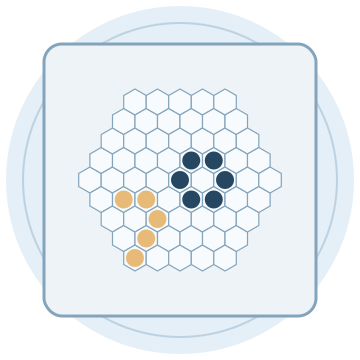
A base-8 hexagonal board of 169 cells with six corners and six edges. Red moves first.
Abstract strategy / HAVANNAH
Win with a ring, a bridge or a fork.
On a hexagonal board, complete a ring, bridge or fork to win.
—online now · 0 matching
Supports ranked matches, friend invites, AI opponents, spectating.
Play instantly in your browser · guests welcome
 HAVANNAH
ABOUT THE GAME
Havannah was invented by the game designer Christian Freeling. It is best played on a base-10 board; this site uses the smaller base-8 board suggested for beginners.
In 2002 Freeling offered a prize of 1000 euros, available through 2012, to any program that could beat him in even one game of a ten-game match. He lost the challenge when he resigned a game as White against the program Lajkonik.
Reference:en.wikipedia.org ↗
Rules
Youzai Board Game Club — The server implementation governs play here; tournament and other site rules may differ.
A base-8 hexagonal board of 169 cells with six corners and six edges. Red moves first.
Players alternate placing a stone on an empty cell; stones never move or get captured. With the pie rule, the second player may take over the first stone instead of placing one.
Complete a ring (enclosing at least one cell), a bridge (linking two corners) or a fork (linking three edges; corners are not edges).
This site uses the smaller base-8 board recommended for beginners. A full board with no winner is a draw.
Complete beginner guide
Read these steps in order to complete your first game. This guide combines public rules with this site’s server implementation; where versions differ, this site’s ruling applies.
The base-8 board starts empty and Red moves first. The first player to complete a ring, bridge or fork wins.
Players alternate placing one stone on any empty cell. Stones never move and are never captured.
To offset the first-move advantage, the second player may use their first turn to take over the opening stone instead of placing one; then the first player moves again.
A loop of connected stones around at least one cell. The enclosed cells may be empty or hold stones of either colour.
A bridge links any two corners. A fork links any three edges; corner cells do not count as edges.
Build several threats at once, since a long chain can turn into a bridge or a fork, and break into an opponent’s ring before it closes.
General rules reference:en.wikipedia.org ↗