
Board and setup
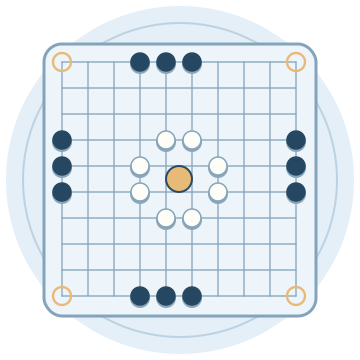
An 11×11 board. The central throne and the four corners admit only the king. Twenty-four attackers start along the edges, twelve defenders and the king in the centre, and the attackers move first.
Abstract strategy / HNEFATAFL
One side hunts, the other breaks out.
Also known as: Viking Chess, Tafl
What makes Hnefatafl compelling is its asymmetry: on the same board one side is closing a net while the other is hunting for a gap.
—online now · 0 matching
Supports ranked matches, friend invites, AI opponents, spectating.
Play instantly in your browser · guests welcome
 HNEFATAFL
ABOUT THE GAME
Hnefatafl is the best known of the Viking-age tafl games, played widely across Scandinavia and carried by settlers to Iceland, the British Isles and beyond. Archaeological and literary evidence points to boards of 13x13 or 11x11.
Its distinguishing feature is asymmetry: one side has twice the men and hunts the other side's king, while the smaller side holds the king and tries to break out.
Tafl faded after chess arrived, and the fine detail of the rules was lost with it. Several modern reconstructions are in use today; this site follows Copenhagen, one of the fuller ones.
Reference:en.wikipedia.org ↗
Rules
Youzai Board Game Club — The server implementation governs play here; tournament and other site rules may differ.
An 11×11 board. The central throne and the four corners admit only the king. Twenty-four attackers start along the edges, twelve defenders and the king in the centre, and the attackers move first.
Every piece moves like a rook in chess: any distance along a row or column, never diagonally and never over another piece. The empty throne may be passed through but not occupied.
The defenders win by walking the king into any corner. The attackers win by capturing the king, or by enclosing the king and every remaining defender in an unbroken ring.
Pieces are captured by sandwiching, and a corner or the throne can stand in for one of the two. The throne is always hostile to attackers but hostile to defenders only while empty. The king needs all four sides (three beside the throne) and cannot be captured on the board edge.
Complete beginner guide
Read these steps in order to complete your first game. This guide combines public rules with this site’s server implementation; where versions differ, this site’s ruling applies.
This is the one asymmetric game on the site. Twenty-four attackers close in from the edges hunting the king; twelve defenders and the king try to reach any of the four corners.
An 11x11 board. The central throne and the four corners admit only the king (the empty throne may be passed through but not occupied). Every piece moves like a rook, any distance along a row or column. The attackers move first.
Sandwich an enemy piece between two of your own to capture it; a corner or the throne can stand in for one of them. Only a sandwich closed by your own move captures. The throne is always hostile to attackers but hostile to defenders only while empty.
The king must be surrounded on all four sides — three when he stands beside the throne — and he cannot be captured on the board edge.
A row of two or more pieces along the board edge is captured together when both ends are bracketed and every member is covered from the inside. A king inside a shieldwall is not captured.
The defenders win by walking the king into any corner. The attackers win by capturing the king or enclosing the king and all remaining defenders in an unbroken ring. A side with no legal move loses, and a repeated position is a loss for the defenders.
General rules reference:en.wikipedia.org ↗