
Board and setup
A 19×19 grid of intersections that starts empty. White moves first and must play the centre point.
Abstract strategy / PENTE
Win with five in a row—or by capturing five pairs.
Gomoku with captures: five in a row or five pairs wins.
—online now · 0 matching
Supports ranked matches, friend invites, AI opponents, spectating.
Play instantly in your browser · guests welcome
 PENTE
PENTEABOUT THE GAME
Pente was created by Gary Gabrel in 1977. It grew out of the gomoku family, particularly the Japanese variant Ninuki-Renju, adding pair captures to the goal of five in a row.
Parker Brothers acquired the game in 1983. This site uses the professional tournament opening: the first player’s second stone must be at least three points from the centre.
Reference:en.wikipedia.org ↗
Rules
Youzai Board Game Club — The server implementation governs play here; tournament and other site rules may differ.
A 19×19 grid of intersections that starts empty. White moves first and must play the centre point.
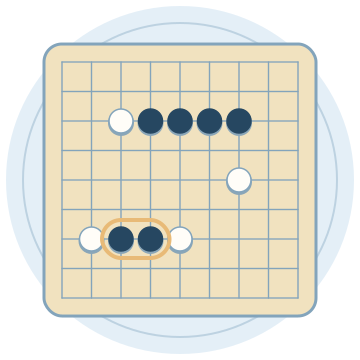
Players alternate placing one stone on any empty point. Flanking exactly two adjacent enemy stones (yours–theirs–theirs–yours) captures them; several pairs can be captured at once. Moving into a flanked position is safe.
Make five or more in a row, or capture five pairs (ten stones). A full board with no winner is a draw.
The professional tournament opening applies: White’s second stone must be at least three points from the centre.
Complete beginner guide
Read these steps in order to complete your first game. This guide combines public rules with this site’s server implementation; where versions differ, this site’s ruling applies.
The 19×19 board starts empty and White moves first. Five in a row or five captured pairs wins. White’s first stone goes on the centre point.
White’s second stone (the third move of the game) must be at least three points from the centre, outside the central 5×5 area.
Players alternate placing a stone on any empty intersection. Stones never move, but they can be captured.
When your stone creates yours–theirs–theirs–yours along a line, the two middle stones are removed; several pairs may go at once. Only exactly two stones are captured, and moving into a flank is safe.
Five or more in a row wins immediately, as does a fifth captured pair. A full board with no winner is a draw.
Avoid pairs with one end already blocked. On defence, look first for a capture that breaks your opponent’s line.
General rules reference:en.wikipedia.org ↗