
Board and setup
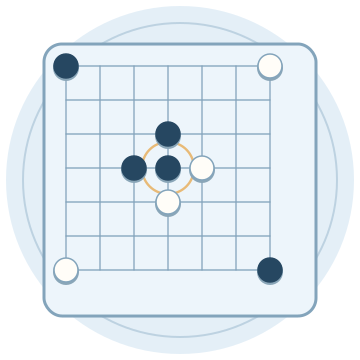
A 7×7 board with one piece in each corner: Red holds top-left and bottom-right, Blue holds top-right and bottom-left. Red moves first.
Abstract strategy / ATAXX
Clone, jump, convert — pieces only ever multiply.
What makes Ataxx compelling is how fast it turns: every landing flips the whole ring around it, so a lead can vanish in a single move.
—online now · 0 matching
Supports ranked matches, friend invites, AI opponents, spectating.
Play instantly in your browser · guests welcome
 ATAXX
ATAXXABOUT THE GAME
Ataxx is a two-player abstract strategy game that began life in the arcades: it was released in 1990 by Leland Corporation as a rebranded version of the 1988 game Infection.
Its rules amount to two moves, yet they produce surprisingly deep positions. A piece can either clone, leaving the original in place and adding a second one beside it, or jump, relocating entirely. Either way every enemy piece in the eight squares around the landing square changes sides. Because nothing is ever removed, the board only fills up.
After the arcades it was ported widely and inspired variants such as Hexxagon, which moves the idea onto a hexagonal board. Simple rules plus swings that can reverse a game in one move have kept it a popular test case for game-playing programs.
Reference:en.wikipedia.org ↗
Rules
Youzai Board Game Club — The server implementation governs play here; tournament and other site rules may differ.
A 7×7 board with one piece in each corner: Red holds top-left and bottom-right, Blue holds top-right and bottom-left. Red moves first.
Pick one of your pieces and an empty square. One square away is a clone — the original stays and a new piece appears. Two squares away is a jump — the piece relocates. Anything further is not legal.
The game ends when the board is full or one side has no pieces left, and whoever has more pieces wins. A player with no legal move is skipped.
After you land, every enemy piece in the eight squares around the landing square becomes yours. Nothing is removed, so the piece count only grows.
Complete beginner guide
Read these steps in order to complete your first game. This guide combines public rules with this site’s server implementation; where versions differ, this site’s ruling applies.
Every move claims ground: clone or jump one of your pieces onto an empty square, and every enemy piece in the ring around it becomes yours. When the board fills up, whoever has more pieces wins.
A 7×7 board with one piece in each corner: Red holds top-left and bottom-right, Blue holds top-right and bottom-left, two apiece. Red moves first.
Pick one of your pieces, then an empty square. One square away (diagonals count) is a clone: the original stays and a new piece appears, so you gain one. Two squares away is a jump: the piece relocates and your total is unchanged. Anything further is not a legal move.
After you land, every enemy piece in the eight squares around the landing square becomes yours. Nothing is captured or removed — the board only fills up. A single move can flip up to eight pieces, so the lead can change hands instantly.
If it is your turn and you have no legal move at all, your turn is skipped and your opponent moves again. Do not let your pieces bunch up until they are sealed in.
The game ends when the board is full or one side has no pieces left, and whoever has more pieces wins. With 49 squares — an odd number — a full board cannot be a draw.
General rules reference:en.wikipedia.org ↗