
Board and setup
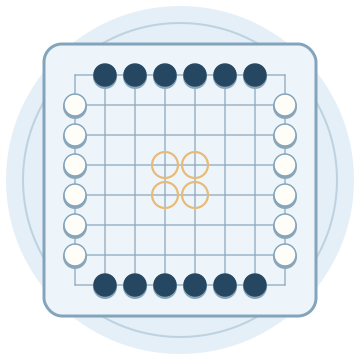
An 8×8 board, twelve pieces each: Black on the middle six squares of the top and bottom rows, White on the middle six of the left and right files. The four corners start empty and Black moves first.
Abstract strategy / LOA
How far you go is up to the board.
Also known as: LOA
The charm of Lines of Action is that you never choose how far to move: a piece travels exactly as many squares as there are checkers on the line it moves along.
—online now · 0 matching
Supports ranked matches, friend invites, AI opponents, spectating.
Play instantly in your browser · guests welcome
 LOA
LOAABOUT THE GAME
Lines of Action is a two-player abstract strategy game designed by Claude Soucie, best known through its inclusion in Sid Sackson's A Gamut of Games (1969).
Its rules are remarkably short, yet they make distance itself a function of the position: a piece moves exactly as many squares as there are checkers on the line it is moving along. Every move therefore changes how far every other piece can travel.
The goal is not to take everything but to gather your own remaining pieces into one connected body. That makes capturing double-edged — take a piece and your opponent has one fewer to unite. A stable high-level community only formed in the 1990s, and the game has long been an event at the Computer Olympiad.
Reference:en.wikipedia.org ↗
Rules
Youzai Board Game Club — The server implementation governs play here; tournament and other site rules may differ.
An 8×8 board, twelve pieces each: Black on the middle six squares of the top and bottom rows, White on the middle six of the left and right files. The four corners start empty and Black moves first.
A piece moves along a row, column or diagonal exactly as many squares as there are checkers on that line — both colours, including the moving piece itself.
Gather all your remaining pieces into one connected group to win, with diagonals counting. A player reduced to a single piece is connected by definition and wins.
You may jump your own pieces but never an enemy piece. You may land on an empty square or capture an enemy piece, but never on your own.
Complete beginner guide
Read these steps in order to complete your first game. This guide combines public rules with this site’s server implementation; where versions differ, this site’s ruling applies.
Gather all of your own pieces into a single connected body — diagonals count — and you win. The catch is that you never choose how far to move; the position does.
An 8×8 board, twelve pieces each. Black takes the middle six squares of the top and bottom rows (b–g), White the middle six of the left and right files (ranks 2–7), and the four corners start empty. Black moves first.
Pick a line — row, column or diagonal — and your piece travels exactly as many squares as there are checkers on that line, counting both colours and the moving piece itself. The line runs across the whole board, so count in both directions. At the start the c-file holds only c8 and c1, so c8 can only go two squares, to c6.
You may jump over your own pieces but never over an enemy piece. You may land on an empty square or on an enemy piece, capturing it, but never on one of your own.
The first player whose remaining pieces form one connected group wins, with diagonal contact counting. A player reduced to a single piece is connected by definition and wins outright — so reducing your opponent to one piece hands them the game. If one move connects both players at once, this site follows current tournament practice and scores it a draw.
More pieces is not automatically better. Take one of your opponent's and they have one fewer to unite; capturing also changes the counts on the lines, which changes how far your own pieces can travel next turn.
General rules reference:en.wikipedia.org ↗