
Board and setup
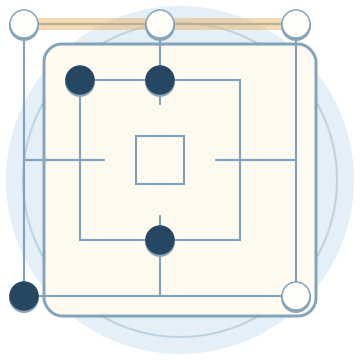
Three concentric squares joined by four cross lines give 24 playable points. Each side has nine pieces and the board starts empty, with White moving first.
Abstract strategy / MORRIS
Line up three, take a piece.
Also known as: Mill, Mills, Merels
Everything in Nine Men's Morris revolves around mills: claim the crossing points while placing, grind out pieces by opening and closing a mill in the middlegame, and watch for the comeback once flying begins.
—online now · 0 matching
Supports ranked matches, friend invites, AI opponents, spectating.
Play instantly in your browser · guests welcome
 MORRIS
ABOUT THE GAME
Nine Men's Morris is recorded across Europe, the Middle East and South Asia. The often-quoted claim that boards at the temple of Kurna in Egypt date to around 1400 BCE is disputed: researchers have pointed out that Coptic crosses among the same set of diagrams can be no earlier than 42 CE, so the carvings cannot be dated with confidence.
Firmer evidence comes from Roman times: Ovid's Ars Amatoria describes a game in which each side has three pieces and the winner is the first to line them up, generally taken to be related. The game peaked in medieval England, where boards are cut into the cloister seats at Canterbury, Gloucester, Norwich, Salisbury and Westminster Abbey.
Nine Men's Morris has been solved by computer: with perfect play from both sides the game is a draw. That takes nothing away from playing it — no human calculates every branch during the placing phase.
Reference:en.wikipedia.org ↗
Rules
Youzai Board Game Club — The server implementation governs play here; tournament and other site rules may differ.
Three concentric squares joined by four cross lines give 24 playable points. Each side has nine pieces and the board starts empty, with White moving first.
First comes placing: players take turns putting a piece on any empty point until both have placed all nine. Then pieces move one step to an adjacent empty point. A side reduced to exactly three pieces may "fly" to any empty point instead.
After a move, three of your pieces in a straight line form a mill and you remove one enemy piece. Reduce your opponent to two pieces, or leave them with no legal move, and they lose.
A piece inside a mill cannot be taken unless every enemy piece is in a mill. Fifty plies without a mill is a draw, and so is the same position occurring three times.
Complete beginner guide
Read these steps in order to complete your first game. This guide combines public rules with this site’s server implementation; where versions differ, this site’s ruling applies.
Three concentric squares joined by four cross lines give 24 playable points. Each side has nine pieces, the board starts empty and White places first.
Placing comes first: players alternate putting a piece on any empty point until all eighteen are down. Then each turn moves one of your pieces to an adjacent empty point. Once a side is reduced to exactly three pieces it may "fly" — move to any empty point on the board.
If a move leaves three of your pieces in a straight line (one of the sixteen mill lines) you have formed a mill and remove one enemy piece. Two restrictions: closing two mills at once still takes only one piece, and a piece inside a mill cannot be taken unless every enemy piece is in a mill.
A mill does not disappear once formed. Move a piece out of it and back on a later turn and the mill forms again, taking another piece. This "open-and-close mill" is the central tactic of the game.
Reduce your opponent to two pieces, or leave them with no legal move, and they lose. Fifty plies by both sides without a mill is a draw, as is the same position occurring three times.
General rules reference:en.wikipedia.org ↗